Non-Monogamy 101: Honest Talk About Open Relationships
Open relationships, explained without hype or judgment: what ENM and polyamory really mean, the agreements that work, and how to handle jealousy.
If you still think comics are just for kids, or for straight guys in spandex punching each other through skyscrapers, you have not been paying attention. Gay comics and LGBTQ superheroes have carved out a loud, proud, permanent space on the shelf, and they are not here to blend in. They are bold, funny, occasionally steamy, and more emotionally honest than whatever continuity-shattering reboot the Big Two are selling this month. From sharp little webcomics that skewer every coming-out cliche to sprawling superhero sagas about love, grief, identity, and survival, queer comics offer something the mainstream spent decades pretending it could not: heroes who are gay on the page, in the lead, and on purpose. This is a quick, opinionated tour of why they have become some of the most addictive reads going, and which characters and books actually earn the hype.
We will name names and cite issues, because the history here is real and worth getting right. No vague “representation matters” hand-waving. Just the actual heroes, the actual creators, and the reasons these stories hit harder than the sanitized version of queerness pop culture usually hands us.
Representation is the baseline, not the prize. The best gay comics blew past the diversity-checkbox era years ago. They treat queerness as a creative engine, not a press release. That means the characters get to be messy, petty, romantic, terrifying, tender, horny, and heroic, sometimes all in the same arc. They are allowed to be people first and symbols second, which is exactly the freedom straight characters have always taken for granted.
That shift matters because comics spent a long time treating gay characters as either invisible or disposable. For most of the medium’s history, queerness could only be hinted at, coded, or killed off for shock value. Modern queer comics flip the script: the gay character does not exist to teach a straight lead a lesson, then die quietly in the third act. They survive. They grow. They get the cliffhanger and the sequel.
If you want proof that LGBTQ superheroes can headline a story without flinching, start with these. Every one of them is canon, with real creators and real issue numbers behind them.
Created by Warren Ellis and Bryan Hitch in the WildStorm corner of the comics world, Midnighter is what you get when Batman stops pretending he is a Hallmark dad. He is brutal, sarcastic, and frighteningly good at violence, and he is also openly gay and devoted to his husband, Apollo, a Superman-style powerhouse. The two are widely regarded as one of the highest-profile same-sex couples in mainstream comics, and their dynamic reads like the World’s Finest partnership with the subtext finally promoted to text.
America Chavez punches holes in reality itself and could not care less whether you approve of her attitude. Created by Joe Casey and Nick Dragotta, she debuted in Vengeance #1 in 2011, and in 2017 she became the first lesbian Latina hero to headline her own Marvel series, written by Gabby Rivera. She is loud, queer, and unbothered, which is precisely the point.
Bobby Drake spent decades as a wisecracking founding X-Man before Marvel let him come out. In All-New X-Men #40 (2015), written by Brian Michael Bendis, the time-displaced teenage Iceman is revealed as gay; later that year, in Uncanny X-Men #600, his adult self confirms he is gay too, admitting he buried it for years. By 2017 he had his first solo ongoing series, built around an out, adult superhero finally living honestly. Coming out did not shrink the character. It made him ten times more interesting.
You cannot talk about LGBTQ superheroes without Northstar. The Alpha Flight speedster became the first openly gay character to come out in a Marvel comic when he declared “I am gay” in Alpha Flight #106 (1992). Two decades later, in Astonishing X-Men #51 (2012), he married his partner Kyle Jinadu in what is recognized as mainstream comics’ first depiction of a same-sex wedding. He is the receipt that proves how far the medium has actually moved.
The very first Green Lantern, who debuted back in 1940, was confirmed as gay in main DC canon in Infinite Frontier #0 (2021), written by James Tynion IV, in a quiet scene where Alan comes out to his adult children. There is something fitting about one of the oldest heroes in the catalog finally getting to be honest about who he always was.
None of these characters exist to be the background “gay friend.” They lead. They fight, they date, they grieve, they flirt, they screw up, and they still save the day, occasionally shirtless, because why not.
Let us talk about heat, because it is part of the appeal and there is no point being coy about it. Indie queer comics in particular do not shy away from desire. You get the full range: slow-burn romance between sworn rivals, forbidden attraction across the hero-villain line, tender domesticity, white-knuckle longing. The tension is real, and it is what keeps readers turning pages at 2 a.m.
But the spice is not really about sex appeal. It is about emotional risk, the vulnerability of wanting someone in a high-stakes world where everything can fall apart. These stories let queer characters be complicated and sexy and human without the genre’s old reflex of punishing them for it. That combination of heat and heart is rarer than it should be, and it is exactly why these books land.
You will also notice that the art in gay comics pulls no punches. It is expressive, vibrant, and frequently fashion-forward, with attention to visual detail that goes well beyond the fight choreography. Outfits matter. Facial expressions matter. And yes, sometimes the abs get more shading than the backgrounds, and that is fine, because these books know their audience and they are having fun with it.
The artwork does narrative work, too. In a series like Alice Oseman’s Heartstopper, little visual flourishes such as sparkles and falling leaves turn private feelings into something you can see on the page: the nerves, the giddiness, the ache of a first crush. The color, the linework, and the character design carry as much emotion as the dialogue, which is the whole point of telling a queer love story in pictures.
If you want to understand why queer comics get taken seriously in literary circles, look past the capes. A handful of graphic novels did the heavy lifting:
Different shelves, same lesson: queer stories sell, win awards, and outlast the doubters.
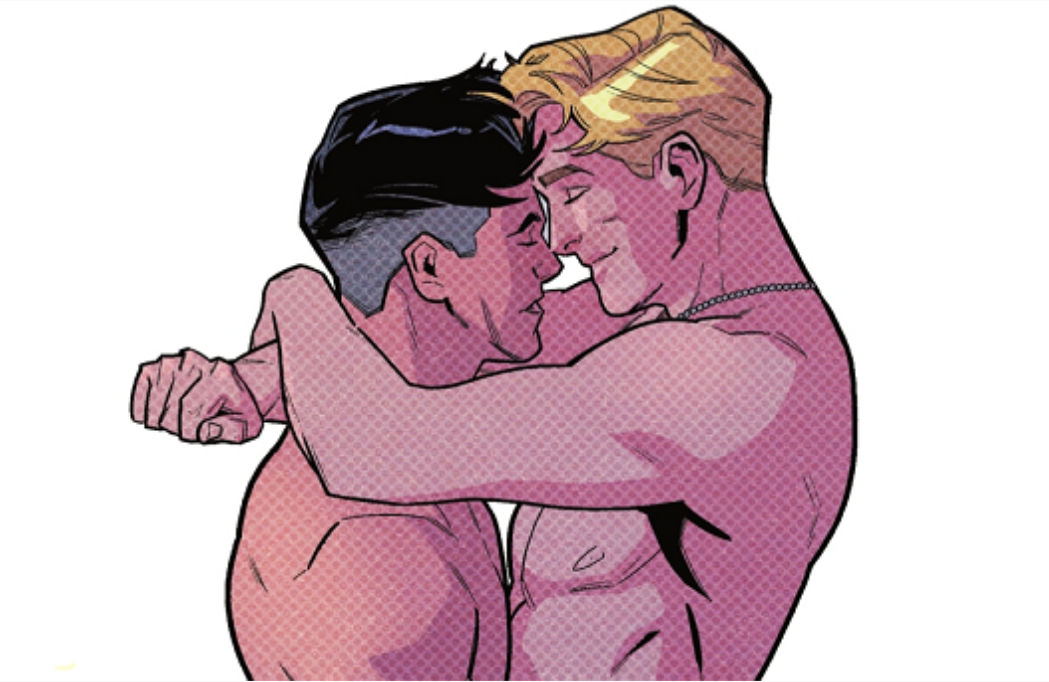
Green Lantern (Alan Scott) and Johnny Ladd by Cypher4.
Gay comics are addictive because they offer something the mainstream rarely manages: real connection wrapped inside pure fantasy. The kind that makes you laugh, then cry, then fan yourself a little. They remind you that being queer does not mean squeezing yourself into someone else’s world. It means building your own and kicking the door off its hinges on the way in.
The momentum is only building. Digital platforms have handed independent creators a direct line to a global audience, which means more voices, more genres, and more stories that never would have made it past a traditional gatekeeper. Major publishers, watching readers vote with their wallets, keep investing in LGBTQ leads and creators. So whether you are a lifelong pull-list devotee or just comic-curious, there has genuinely never been a better time to dive in. The bold stories, the unforgettable heroes, the unfiltered love and identity, all of it is waiting, and it is far more interesting than whatever is getting rebooted this week.
Northstar, of Alpha Flight, was the first character to openly come out in a Marvel comic, declaring “I am gay” in Alpha Flight #106 in 1992. In 2012 he also took part in mainstream comics’ first same-sex wedding, marrying Kyle Jinadu in Astonishing X-Men #51.
Yes. Alan Scott, the Green Lantern who first appeared in 1940, was confirmed as gay in DC’s main continuity in Infinite Frontier #0 (2021), written by James Tynion IV. Note this is the Golden Age hero Alan Scott, not the later, separate Green Lantern Hal Jordan.
Not at all. Some of the most acclaimed queer comics are personal and literary rather than action-driven. Alison Bechdel’s memoir Fun Home won an Eisner Award and inspired a Tony-winning musical, while Alice Oseman’s Heartstopper is a contemporary romance that became a hit Netflix series. The genre spans memoir, romance, fantasy, and everything between.
For superhero action, the Iceman solo series and America Chavez’s solo run are both accessible entry points with out queer leads. If you want a romance-forward couple, Midnighter and Apollo are a fan favorite. Outside capes entirely, Heartstopper and Fun Home are the easiest on-ramps to queer comics as a whole.
Because they let LGBTQ characters be full people, not symbols or tragedies. Instead of being hinted at or killed off, these heroes get to lead, love, and survive across long-running stories, which gives the writing an emotional honesty and stakes that more cautious mainstream books often lack.
Keep reading: why queer art has always been louder than permission.
Grab the look: Funny Gay Shirts, Gay Pride Shirts, Parody & Meme Shirts, Gay Couples Shirts, and Holiday Shirts.
Open relationships, explained without hype or judgment: what ENM and polyamory really mean, the agreements that work, and how to handle jealousy.

Same-sex marriage worldwide in 2026: nearly 40 countries say yes, dozens still criminalize. See where it’s legal, what’s new, and what’s contested.

Situationships, soft launching, breadcrumbing, the talking stage: a witty, accurate guide to modern dating terms through a queer lens. Decode it here.
Demon twinks, haunted hookups and costumes that require zero effort.
Tees from $29.99.